

Blockchain technology is transforming many areas such as banking, logistics, and healthcare. Originally, it was used for cryptocurrencies. Now, it contributes to efficiency and transparency across various sectors.
In the financial world, it makes payments faster and more secure. This is possible because it eliminates intermediaries. It also lowers costs. In logistics, it ensures product authenticity and combats fraud. In healthcare, it improves the management of health records. It also helps with medication verification and medical research. In the energy sector, it drives smart electrical grids. It also enables direct energy sales.
To stand out in the digital economic future, specializing in blockchain is vital. The University of Salamanca, for example, offers advanced study programs. These prepare professionals for future digital challenges.
Key Aspects
- Blockchain technology has transcended its origins in cryptocurrencies.
- In banking, it redefines financial transactions by enabling faster and more secure payments.
- In the supply chain, it ensures authenticity and reduces fraud.
- It improves the management of medical records in healthcare.
- It enables the creation of smart electrical grids in the energy sector.
- Specializing in blockchain is strategic for the digital economy of the future.
What is Blockchain Technology
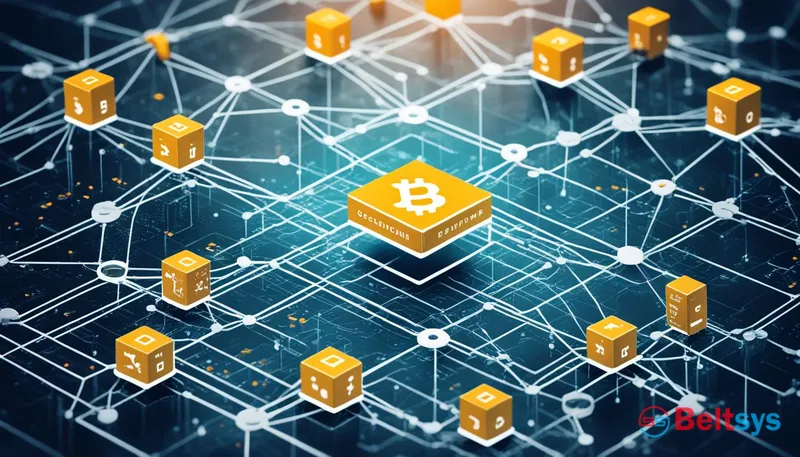
Blockchain technology is a decentralized system that stores information in blocks. It has changed various sectors, not just finance. It offers benefits such as authenticity and data tracking without the need for third parties.
Definition and Operation
Blockchain acts as an immutable ledger for transactions. It records and tracks assets, whether physical things or intellectual property rights. Being decentralized, it improves the immediacy and security of data, visible only to authorized users.
Origin and Evolution
Blockchain technology has grown rapidly over the past decade. Interest has risen since 2013, indicating its consolidation. It started with Bitcoin and the Proof of Work consensus method, but has evolved toward more efficient systems.
There are public and private blockchains, such as Bitcoin, Ethereum, and Hyperledger. Their flexibility facilitates use by governments and enterprises in exclusive networks.
A 2022 study predicts that the blockchain market will reach $40 trillion by 2025. This highlights the growing role of this technology in the global economy.
Applications in the Financial Sector
The financial sector is experiencing a revolution with Blockchain technology. This technology removes intermediaries and makes operations faster. This has attracted the attention of major banks worldwide.
Secure and Fast Payments
Blockchain makes payments secure and fast. For example, Banco Santander uses Blockchain in One Pay FX for cross-border payments. This makes transactions cheaper and faster. There is also significant investment in new Blockchain-based solutions.
BBVA allows Bitcoin purchases in Switzerland. Meanwhile, Banco Santander used Blockchain to issue a bond in 2019. This process makes payments more secure by avoiding intermediaries and recording everything permanently.
Cryptocurrencies and Smart Contracts
Cryptocurrencies and smart contracts are changing finance. Major banks like JP Morgan and Goldman Sachs already offer cryptocurrency services. Decentralized finance (DeFi) moves millions of euros and offers new products.
Much is expected from central bank digital currency (CBDC) on Blockchain. This could make cryptocurrency use easier for everyone. SWIFT is working to move digital currencies and tokenized assets. This could be worth $4 trillion by 2030.
The next five years are important for Blockchain in finance. Banks are rapidly adopting this technology. It shows its capacity to change the market, secure payments, and expand the use of cryptocurrencies and smart contracts.
Impact on the Supply Chain
Blockchain technology has revolutionized the supply chain. Now it is possible to have better traceability and product authenticity. Companies like Deoleo and ChainGO Tech already use IBM Food Trust to be more efficient and transparent.
Traceability and Authenticity
Thanks to blockchain, products can be monitored in real time – where they are, their condition, and how long they take to arrive. This improves inventory control. Additionally, customers can be sure of where and how the products they buy are made. Walmart uses this technology to be more transparent in its supply chain.
Fraud Reduction
Blockchain helps greatly in preventing fraud. It ensures that products are authentic and from where they claim to be. Smart contracts make processes more direct, with fewer intermediaries, increasing efficiency and reducing errors or cyberattacks. The value of the blockchain supply chain was $253 million in 2020. It is expected to grow to $3,272 million by 2026.
Ripple and Filecoin show how blockchain can specialize, improving international payments and cloud storage. These innovations show that blockchain can lower costs, improve efficiency, and make logistics operations more transparent globally.
Transformation in Healthcare
Healthcare is changing thanks to Blockchain technology. This technology makes medical records secure and tamper-proof without altering the entire system. It is a decentralized network of nodes.
Medical Records Management
Medical records are better managed with Blockchain. Hospitals and doctors share patient information securely. This saves time and resources, avoiding duplicate exams and procedures.
Blockchain improves control of medical records and patient care by reducing duplicate medical practices.
Data security is vital. Blockchain protects information and allows instant access. This makes healthcare more efficient.
Clinical Research
Blockchain also helps in clinical research. It facilitates secure transmission of important data and its management. Networks like Alastria improve data protection and help develop new treatments.
This technology adds integrity and visibility to medications, from production to when they reach pharmacies. It closely follows each step of the process to prevent distribution problems.
Blockchain in the Energy Industry
The energy industry is changing significantly due to the use of blockchain technology. This technological development helps track renewable energy. It also facilitates energy trading. Major companies like Iberdrola already use blockchain to make electrical grid management more sustainable and efficient.
Renewable Energy Traceability
Thanks to blockchain, energy companies can now demonstrate that energy is 100% green. Smart contracts and automatic certification ensure that energy comes from renewable sources. This clarity is key to achieving sustainability goals and earning customer trust.
Direct Energy Trading
Blockchain has created peer-to-peer (P2P) energy exchange models. These models remove intermediaries, lowering costs and transaction times. Now, energy consumers and producers can do business directly. This makes the energy market more active and user-friendly.
Additionally, managing energy demand effectively is now easier. Distributed generation allows users to also be producers. This promotes an energy system that is more resilient and greener.
While there are many benefits, there are still obstacles to full adoption of this technology. One of them is the lack of a common standard and how to make blockchain solutions scalable. But with efforts toward creating standards and favorable regulations, blockchain could completely transform the energy industry.
Logistics Sector and Blockchain
Blockchain technology has renewed the logistics sector. Now inventory and route management can be improved. Walmart, Nestle, and FedEx use this technology to track their products. This improves the efficiency and transparency of their supply chains.
Route Optimization and Inventory Management
Thanks to blockchain, inventory management is more efficient and accurate. Errors can be avoided and unnecessary costs reduced. Maersk uses this technology to monitor cargo and save a lot of money in transportation.
This technology also makes transportation routes more efficient. Empty trips are reduced, improving delivery. Visa has launched B2B Connect, which uses blockchain for secure payments between countries.
Transparency in the Logistics Chain
Blockchain makes the logistics chain more transparent. It guarantees a clear record of all movements. This increases trust and reduces fraud. ChainGO Tech has shown how blockchain can simplify and protect logistics processes.
In conclusion, blockchain is revolutionizing logistics chain management. It improves everything from how inventories are managed to how transparency and security are ensured. Its influence will continue to grow in the industry.
The Importance of Security in Blockchain
Blockchain technology stands out for its security, using decentralized systems and advanced encryption. This is vital in sectors with sensitive data, because it offers protection against hacks and unwanted manipulations.
Blockchain makes transactions more transparent by permanently recording each one. Thanks to its decentralized nature, it is harder to suffer attacks that alter information. This is due to data being dispersed across many nodes.
Decentralized and Encrypted Systems
Cryptography in blockchain protects information security. This guarantees the confidentiality, integrity, and authenticity of data. It helps prevent identity theft and allows permanent investigation of any security breach.
Smart contracts improve cybersecurity. They automate access controls and detection of unusual activities. For example, Telefonica’s Latch uses blockchain and multifactor authentication to reinforce web security.
Buguroo with its bugFraud solution uses blockchain for a secure record of online transactions. It helps identify fraud and sends alerts to prevent large-scale financial crimes.
Economic Benefits of Blockchain Technology
Since 2008, blockchain technology has been a great advance. It is used in automotive, financial services, and more. The economic benefits include lower operational costs and not needing as many intermediaries. This improves processes and efficiency.
Blockchain significantly reduces costs in capital markets. For example, in Latin America and the Caribbean, a blockchain bond of COP 110 million was launched. This bond improved time and costs in Colombia.
Blockchain also allows dividing digital assets, making it easier to sell and transfer bonds. It increases liquidity and investors. In healthcare, it improves patient data security and helps in record exchange.
In pharmaceuticals, products can be better tracked, reducing counterfeiting. In government, it generates trust by sharing data securely and offers a way to audit contracts and services.
For insurance, the use of smart contracts streamlines and lowers management costs. It helps prevent fraud and improves processes.
Use Cases in the Agri-Food Sector
The agri-food sector is being transformed by blockchain technology. It improves how we manage food quality and consumer information. Now, consumers can know where their food comes from and how it is processed.
The use of blockchain not only helps consumers trust more. It also makes companies more responsible. Traceability technology improves the relationship between all participants from farming to consumption.
Quality Control and Food Safety
Blockchain is key in agriculture to ensure food quality and safety. It is used in the production of olive oil, wine, meat, and more. This prevents fraud and manipulation, ensuring that food is authentic.
Thanks to this technology, we can follow every step of production in real time. This guarantees the integrity of products from field to table.
Accurate Information for Consumers
Consumers want to know more about their food. Thus, blockchain has become essential. Galpagro, Rurapolis, and Oleocano, with OliveTrace, provide details about extra virgin olive oil with a QR code.
Carrefour works with IBM and Coren on the “Quality and Origin” chicken. This initiative unites everyone in the food supply chain. It offers complete transparency.
Cibernos is driving the integration of blockchain in the agri-food sector. By 2025, this technology is expected to be common, replacing old databases.
Blockchain Adoption in the Public Sector
Blockchain technology is revolutionizing the public sector. Now, the transparency and efficiency of government services are improving. Governments are adopting it to more effectively control funds. This way, they can offer citizens clearer and more secure services.
Digital Identity Management
A key application of blockchain in the public sector is managing digital identity. This technology promises to store personal data securely. This simplifies and makes procedures more secure. For example, the Madrid City Council already uses blockchain to improve its processes and protect digital identity.
Public Fund Transparency
Transparent management of public funds is fundamental. Blockchain records each operation in an unalterable record. This makes it very difficult to change information without notifications. In this way, corruption is fought and public trust is gained. IBM Think Spain pointed out in 2017 how blockchain drives trust in government services.
Deloitte, in 2019, discussed how blockchain can be practical for the public sector. It highlighted how it can transform and improve efficiency and reliability in government transactions.
Although there are obstacles in blockchain adoption by the public sector, the benefits are already notable. The management of public funds and digital identity systems improve thanks to it. This advance toward decentralization ensures more transparent, secure, and efficient administration.
Specialization Opportunities in Blockchain
Blockchain technology is being used more every day. Because of this, the need for blockchain specialists has greatly increased. Those interested in a career in blockchain have various blockchain training options and specific certifications within reach.
Demand for Specialists
Companies need experts capable of using blockchain. They look for people with technical and business knowledge. Because of this, there are many available jobs and specific courses to learn.
Training and Certifications
Universities and online platforms, such as the University of Salamanca and Euroinnova, offer blockchain training. These courses cover topics from the most basic to the most advanced. For example, Euroinnova has a 300-hour course that students rate very highly.
These courses are flexible and easy to access. Euroinnova offers scholarships and aid, making learning easy. Over 300,000 students, including 25% from other countries, recommend Euroinnova. They greatly appreciate the quality of teaching.
“The Blockchain and Business specialization course at Euroinnova greatly improved my career. The professors and live classes helped me learn.” – Euroinnova student
Conclusion
The blockchain revolution has changed many areas such as finance and records management. It offers security and transparency to various sectors thanks to decentralization. This improves trust and facilitates operations management.
While its use in small businesses is still limited, the benefits are significant. Countries like Honduras show how blockchain can be useful in large projects. It is important that the public sector and private sector see this as an opportunity for a better economy.
The debate about how to regulate blockchain is important. Regulating too early can be bad for innovation. If not regulated, there can be misuse. Even so, a good plan and blockchain training are very promising. Using this technology in the supply chain lowers costs by 40% and improves payments by 50%.
To conclude, the blockchain revolution continues to advance. It improves traceability and costs, earning the trust of many consumers. It is not just a trend, but a key part of digital innovation toward a better future.
FAQ
What is blockchain technology?
It is a method for storing and protecting information in linked blocks. This technology operates without the need for central control.
What are the applications of blockchain in the financial sector?
In finance, blockchain makes payments more secure and faster. It uses cryptocurrencies and smart contracts to make direct transactions.
How does blockchain impact the supply chain?
It ensures and verifies the authenticity of products in the supply chain. This reduces fraud and improves tracking efficiency.
How does blockchain transform healthcare?
It improves how medical records are managed, making it more secure. With the help of technologies like Hyperledger Fabric, it also reduces healthcare costs.
How is blockchain applied in the energy industry?
It is used to certify renewable energy and improve electrical grid management. The technology enables direct energy sales, as in the case of Iberdrola.
What benefits does blockchain have in the logistics sector?
It optimizes logistics chain management, from inventories to routes. This increases efficiency and can lower costs.
Why is security important in blockchain?
Its security comes from its decentralization and encryption. This makes attacks or manipulations much less likely.
What are the economic benefits of implementing blockchain?
It reduces operational costs and eliminates many intermediaries. This lowers expenses and creates new business opportunities.
How is blockchain used in the agri-food sector?
It helps track the journey of food, from its origin to the consumer. This increases buyer trust.
How does the public sector adopt blockchain technology?
It facilitates more transparent and efficient government services. This includes better management of digital identity and public funds.
What specialization opportunities exist in blockchain?
There is high demand for blockchain specialists. Institutions like the University of Salamanca offer training to prepare for this emerging field.