

Every enterprise asking about LLM fine-tuning has the same question: “Should we fine-tune, use RAG, or just improve our prompts?” The answer depends on your task, data, budget, latency requirements, and security posture. Yet no guide on Google provides a clear decision framework — Unsloth sells its tool, Lakera sells security, DataCamp sells courses.
This guide synthesizes the technical depth of Unsloth, the security perspective of Lakera, and the academic rigor of the arXiv comprehensive survey — with an enterprise decision framework and cost analysis that none of them provide.
What Is Fine-Tuning? And Why It Matters for Enterprises
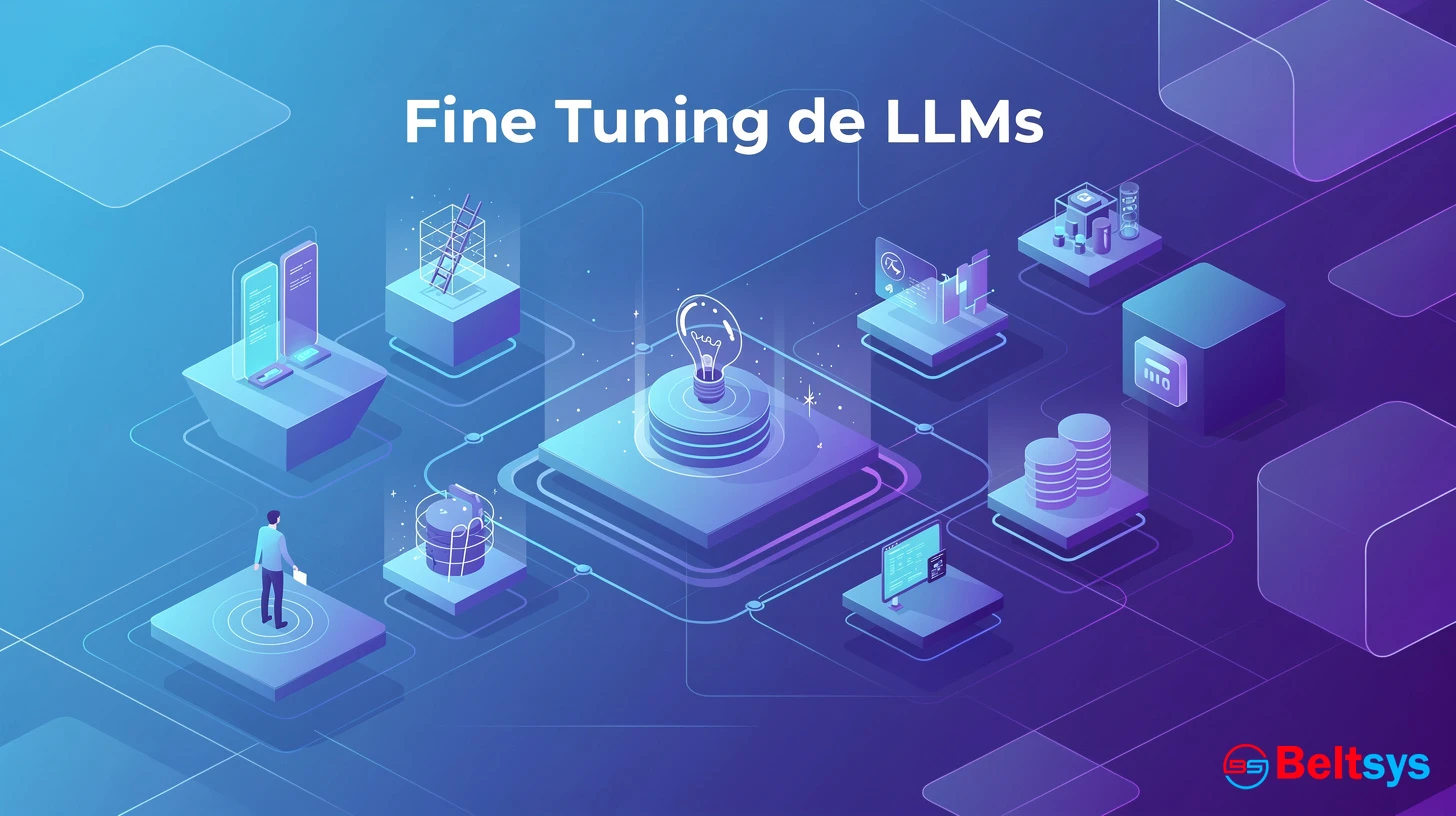
LLM fine-tuning is the process of taking a pre-trained language model and re-training it on domain-specific data to customize its behavior. It’s a subset of transfer learning: you leverage the model’s existing knowledge and adapt it to your use case.
| Pre-training | Fine-tuning |
|---|---|
| Trains from scratch on trillions of tokens | Adapts an already-trained model |
| Requires thousands of GPUs for weeks | Can be done on 1 GPU in hours |
| Cost: millions of dollars | Cost: $10-$10,000 (depends on size) |
| General knowledge | Domain-specific knowledge |
| Done by OpenAI, Meta, Google | Can be done by any enterprise |
Why it matters now: enterprises are paying $16-21 CPC for fine-tuning expertise — among the highest CPCs in the entire AI keyword space. The demand is real, the expertise is scarce.
Fine-Tuning vs RAG vs Prompting: The Decision Framework
The framework no competitor provides:
| Criterion | Prompting | RAG | Fine-tuning |
|---|---|---|---|
| When to use | Generic tasks, experimentation | Frequently changing knowledge | Specific, stable behavior |
| Data needed | None | Documents / knowledge base | Hundreds to thousands of input-output pairs |
| Initial cost | $0 (API) | $500-5,000 (vector infra) | $10-10,000 (GPU) |
| Recurring cost | High (tokens per call) | Medium (hosting + API) | Low (local model hosting) |
| Latency | Variable (API) | Higher (search + generation) | Lower (optimized local model) |
| Data privacy | Data goes to cloud | Documents on your server | Data stays on your server |
| Update speed | Instant (change prompt) | Fast (update documents) | Slow (re-train) |
| Customization | Low-medium | Medium | High |
| Best for | Prototypes, exploration | Support, FAQs, documentation | Tone, format, specialized tasks |
Practical rule:
- Need the model to know updated information? → RAG
- Need the model to behave a specific way? → Fine-tuning
- Need both? → RAG + fine-tuning (the most powerful combination)
Unsloth’s controversial claim: Fine-tuning can replicate ALL RAG capabilities. This is technically possible (train the model on your documents) but impractical for most enterprises — knowledge changes frequently, and re-training is slower than updating a RAG index. The claim holds for static, specialized knowledge; it fails for dynamic, frequently updated content.
Fine-Tuning Methods in 2026
Core Methods
| Method | Complexity | GPU Required | What It Does |
|---|---|---|---|
| SFT (Supervised Fine-Tuning) | Low | Medium-high | Trains on curated input-output pairs |
| LoRA (Low-Rank Adaptation) | Low-medium | Low (10-100x less VRAM) | Trains only adapter layers — 1% of weights |
| QLoRA (Quantized LoRA) | Medium | Very low (3GB minimum) | 4-bit quantization + LoRA — 65B+ on consumer GPU |
| PEFT | Low-medium | Low | HuggingFace library: LoRA, prefix-tuning, prompt-tuning |
Alignment Methods
| Method | Complexity | What It Does |
|---|---|---|
| RLHF (Reinforcement Learning from Human Feedback) | High | Trains reward model from human preferences, then optimizes LLM |
| DPO (Direct Preference Optimization) | Medium | Simpler RLHF — no reward model needed, direct preference learning |
| GRPO (Group Relative Policy Optimization) | Medium | DeepSeek’s method — groups samples for more efficient optimization |
| ORPO (Odds Ratio Preference Optimization) | Medium | Combines SFT and alignment in a single training step |
LoRA is the breakthrough that democratized fine-tuning: by training only 1% of model weights, it reduces GPU/VRAM needs by 10-100x. QLoRA takes it further — quantizing to 4 bits enables fine-tuning 65B+ parameter models on a single consumer GPU with just 3GB VRAM (Unsloth).
Choosing a Model for Fine-Tuning (2026)
| Model | Sizes | License | Differentiator | Fine-tuning Score |
|---|---|---|---|---|
| Llama 3.x (Meta) | 8B, 70B, 405B | Open (with restrictions) | Best ecosystem (HuggingFace) | ✓✓✓ |
| Mistral | 7B, 8x7B (Mixtral), Large | Apache 2.0 / commercial | Best quality/parameter ratio | ✓✓✓ |
| DeepSeek-R1 | 7B, 67B, V3 | MIT | Strong reasoning and code | ✓✓ (Chinese character risk) |
| Qwen 2.5 (Alibaba) | 7B, 14B, 72B | Apache 2.0 | Strong multilingual, math | ✓✓ |
| Gemma 2 (Google) | 2B, 9B | Permissive | Light, ideal for edge/mobile | ✓✓ |
| Phi-3/4 (Microsoft) | 3B, 14B | MIT | Ultra-light, surprising quality | ✓✓ |
Real-world experience: DeepSeek failed (generated Chinese characters), Llama failed, Mistral 7B succeeded in a practical fine-tuning project. Lesson: always test 2-3 models before committing.
Fine-Tuning Tools and Frameworks
| Framework | Speed | Ease of Use | Differentiator |
|---|---|---|---|
| Unsloth | 2x faster than baseline | Medium | Fastest LoRA/QLoRA; Studio for no-code |
| HuggingFace Transformers | Baseline | High | Largest ecosystem, most tutorials |
| Axolotl | Fast | Medium | YAML config, multi-method support |
| LitGPT | Fast | Medium | Lightning AI, clean API |
| torchtune | Fast | Medium | Meta’s official, PyTorch-native |
| Google Vertex AI | N/A (managed) | High | Enterprise-grade, fully managed |
How Much Does Fine-Tuning Cost?
| Approach | Initial Cost | Monthly Cost | Privacy | Customization |
|---|---|---|---|---|
| API (GPT-4, Claude) | $0 | $500-5,000+ (tokens) | Data goes to cloud | Low (prompt only) |
| RAG + API | $500-3,000 | $300-2,000 (API + hosting) | Documents local | Medium |
| Fine-tuning (7B, LoRA) | $10-100 (GPU) | $50-200 (model hosting) | 100% on-premise | High |
| Fine-tuning (70B, QLoRA) | $50-500 (GPU) | $200-1,000 (hosting) | 100% on-premise | Very high |
| Fine-tuning + RAG | $500-3,000 | $200-1,000 | Hybrid configurable | Maximum |
Where to train:
| Platform | GPU | Cost | Best For |
|---|---|---|---|
| Google Colab | T4 (15GB) | Free | Experimentation |
| Kaggle | P100/T4 | Free (30h/week) | 7B model fine-tuning |
| Lambda Labs | A100 (80GB) | $1.10/hr | Serious fine-tuning |
| RunPod | A100, H100 | From $0.39/hr | Production |
| Vast.ai | Variable | From $0.10/hr | Minimum budget |
Security Risks: Data Poisoning, Prompt Injection, and Model Extraction
Lakera highlights critical security concerns that most fine-tuning guides ignore:
| Risk | Description | Mitigation |
|---|---|---|
| Data poisoning | Malicious data in training set corrupts model behavior | Data validation, provenance tracking |
| Prompt injection | Fine-tuned models remain vulnerable to adversarial prompts | Input sanitization, Lakera Guard |
| Model extraction | Attackers reconstruct your fine-tuned model via API queries | Rate limiting, output filtering |
| Training data leakage | Model memorizes and reveals sensitive training data | Differential privacy, data deduplication |
| Backdoor attacks | Hidden triggers in training data activate malicious behavior | Adversarial testing, red teaming |
Dropbox uses Lakera Guard for LLM security with their fine-tuned models. If you’re fine-tuning with proprietary or sensitive data, security isn’t optional — it’s foundational.
Fine-Tuning for Blockchain and Web3
At Beltsys, we apply LLM fine-tuning for Web3 use cases:
- Models trained on Solidity for smart contract generation and auditing
- LLMs specialized in ERC-3643, ERC-4337 documentation and tokenization standards
- RAG + fine-tuned chatbots for Web3 platform technical support
- Fine-tuned agents for on-chain transaction analysis and DeFi protocol interaction
The combination of fine-tuning + RAG is ideal for fintechs and blockchain companies that need models speaking their technical language with current data. Blockchain & AI consulting.
EU AI Act and Fine-Tuned Models
The EU AI Act raises an unresolved question: is a fine-tuned model a “new” AI system?
- Substantial behavior modification → may classify as new system → mandatory compliance
- Minor adaptation (tone/format) → probably not
- Recommendation: Document the fine-tuning process, training data, and evaluations. If your model makes decisions in healthcare, finance, or hiring, assume you need compliance.
- Deadline: August 2, 2026. Penalties: up to €35M or 7% of global revenue.
Frequently Asked Questions About LLM Fine-Tuning
What is LLM fine-tuning?
LLM fine-tuning is the process of re-training a pre-trained language model with domain-specific data to customize its behavior. It’s a subset of transfer learning — you leverage existing knowledge and adapt it to your use case. Key techniques include LoRA (trains 1% of weights), QLoRA (4-bit quantization for consumer GPUs), and DPO (alignment without reward model).
When should I fine-tune vs use RAG?
Fine-tune when you need the model to behave a specific way (tone, format, specialized responses). Use RAG when you need the model to know updated information (documentation, FAQs). Use both for maximum customization with current knowledge. Fine-tuning is better for static, specialized knowledge; RAG for dynamic content.
How much does LLM fine-tuning cost?
A 7B model with LoRA: $10-100 in GPU costs (2-4 hours). A 70B model with QLoRA: $50-500. Monthly hosting: $50-1,000 depending on model size. Free options: Google Colab, Kaggle (30h/week GPU). Compared to API costs ($500-5,000+/month), fine-tuning is cheaper long-term and keeps data on-premise.
What is LoRA and why does it matter?
LoRA (Low-Rank Adaptation) trains only adapter layers — approximately 1% of model weights — reducing GPU/VRAM requirements by 10-100x. QLoRA adds 4-bit quantization, enabling fine-tuning of 65B+ parameter models on a single consumer GPU with just 3GB VRAM. These techniques democratized fine-tuning for enterprises of all sizes.
Is fine-tuning secure?
Not automatically. Lakera warns that fine-tuned models remain vulnerable to prompt injection, data poisoning, training data leakage, and model extraction attacks. Dropbox uses Lakera Guard for LLM security. If fine-tuning with proprietary data: implement data validation, differential privacy, input sanitization, and adversarial testing.
Does the EU AI Act apply to fine-tuned models?
Potentially. If fine-tuning substantially modifies model behavior, it may create a “new” AI system requiring compliance. For models making decisions in healthcare, finance, or hiring, assume compliance is needed. Document training data, process, and evaluations. Deadline: August 2, 2026. Penalties: €35M or 7% revenue.
About the Author
Beltsys is a Spanish blockchain and AI development company specializing in LLM fine-tuning for Web3, smart contracts, and fintech solutions. With extensive experience across more than 300 projects since 2016, Beltsys implements custom models with RAG and fine-tuning for enterprises that need AI speaking their technical language. Learn more about Beltsys
Related: Smart Contract Development Related: Web3 Development Related: Blockchain Consulting Related: Real Estate Tokenization