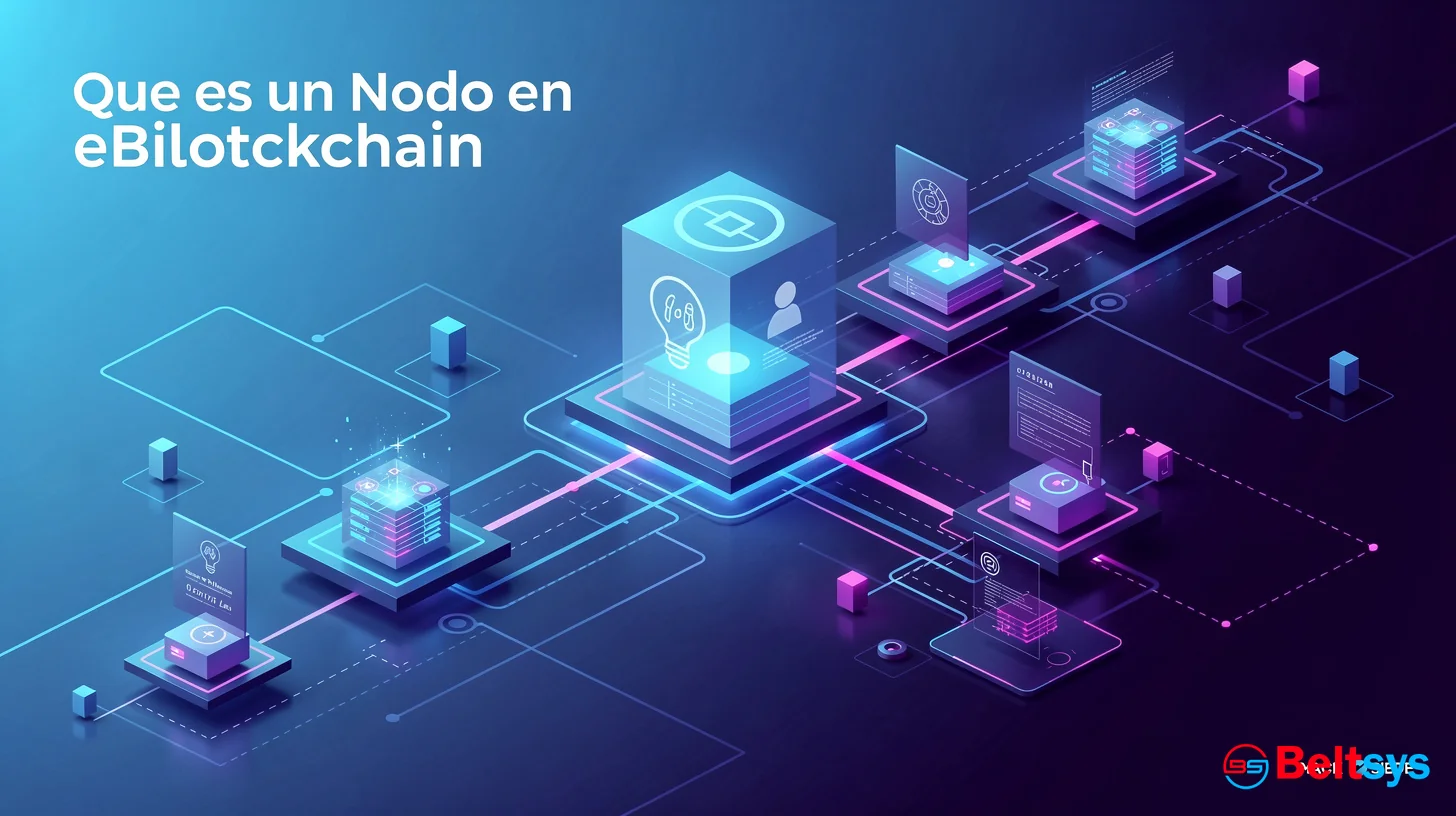



What Is Blockchain: A Complete Guide for Businesses in 2026
Picture a ledger that nobody can tamper with, that belongs to no single entity, and that any participant can verify in real time. That, in essence, is blockchain. But reducing it to that definition would be like saying the internet is “a network of connected computers”: technically accurate, wildly insufficient.
Over the past two years, enterprise blockchain adoption has shifted from promise to measurable reality. According to Statista, global spending on blockchain solutions surpassed $19 billion in 2024, with 2026 projections pointing to over $67 billion. The World Economic Forum estimates that by 2027, 10% of global GDP will be stored on blockchain infrastructure.
Whether you run a company, lead a technology department, or simply want to understand why this technology keeps appearing in every conversation about digital transformation, this guide is for you. We will walk from the technical foundations to the use cases already delivering ROI, including the mistakes you should avoid.
Blockchain fundamentals: how it actually works
The block-and-chain structure
A blockchain is, literally, a chain of blocks. Each block contains three essential elements:
- Data: the transactions or records being stored (value transfers, contracts, certificates, anything).
- Current block hash: a unique digital fingerprint generated via cryptography. Change a single character in the data and the hash changes completely.
- Previous block hash: the link connecting each block to the one before it, forming the chain.
This structure makes tampering computationally infeasible. To alter a record in block number 50, you would need to recalculate the hashes of every subsequent block, and do it faster than the rest of the network. On a network like Ethereum, with thousands of validator nodes distributed around the world, that is practically impossible.
Decentralization: why it matters
In traditional systems, a database lives on a server (or server cluster) controlled by a central entity. Your bank, for example, maintains the record of your balance. You trust that record is correct.
Blockchain removes that dependency. The database is replicated across hundreds or thousands of independent nodes. Each node verifies transactions autonomously. You don’t need to trust any intermediary because the mathematical protocol guarantees integrity.
This doesn’t mean intermediaries vanish overnight. It means that where they were once mandatory, they are now optional. That difference changes the rules of the game for entire sectors.
Consensus mechanisms: PoW, PoS, and beyond
For thousands of nodes to agree without a central authority, blockchain uses consensus mechanisms. The two main ones are:
| Mechanism | How It Works | Advantages | Limitations |
|---|---|---|---|
| Proof of Work (PoW) | Miners compete to solve complex cryptographic puzzles. The first to solve it validates the block. | Maximum proven security (Bitcoin has run 15+ years without being compromised) | High energy consumption, lower transaction throughput |
| Proof of Stake (PoS) | Validators deposit tokens as collateral. They are selected to validate blocks proportionally to their stake. | Energy efficiency (~99.95% less than PoW), greater scalability | Shorter security track record, tendency toward stake centralization |
Ethereum completed its migration to PoS (known as “The Merge”) in September 2022, cutting its energy consumption by 99.95%. This move eliminated one of the main enterprise objections to the technology.
Other emerging mechanisms include Proof of Authority (ideal for private blockchains), Delegated Proof of Stake (used by networks like EOS), and zero-knowledge proofs (ZK proofs), which allow information to be verified without revealing it, a revolution for enterprise privacy.
Types of blockchain: public, private, and hybrid
There is no single “blockchain.” Different architectures exist, each with its own strengths depending on the use case.
Public blockchain
Anyone can participate as a node, validate transactions, and read the full history. Bitcoin and Ethereum are the best-known examples.
Best for: total transparency, token issuance, DeFi applications, open markets.
Enterprise consideration: data is public. If you need transaction privacy, a public blockchain alone isn’t enough, though solutions like ZK rollups are closing that gap.
Private (permissioned) blockchain
Only authorized participants can access the network. Hyperledger Fabric, developed by the Linux Foundation, is the most widely used framework in corporate environments.
Best for: supply chains, medical records, internal banking systems, asset traceability.
Consideration: you sacrifice some decentralization in exchange for performance, privacy, and control. For many enterprises, that is an acceptable trade-off.
Hybrid and consortium blockchain
Combines elements of both. A group of organizations manages the network (consortium), but certain data can be public. R3 Corda, widely used in banking, is one example.
Best for: regulated industries where multiple companies need to share data in a controlled manner (insurance, international trade, energy).
Blockchain vs. traditional databases: when does it make sense?
A question we hear constantly in our consulting engagements: “Why not just use a regular database?” It’s a fair question, and the honest answer is that in many cases a traditional database is the better choice. What matters is knowing when it isn’t.
| Feature | Traditional Database | Blockchain |
|---|---|---|
| Control | A single entity administers and modifies data | Multiple parties validate and maintain the record |
| Trust | Requires trusting the administrator | The protocol guarantees integrity (trustless) |
| Data modification | Records can be edited and deleted | Records are immutable (append-only, never deleted) |
| Performance | Thousands to millions of transactions per second | Tens to thousands (depending on architecture) |
| Operational cost | Centralized infrastructure, predictable costs | Gas fees (public) or node infrastructure (private) |
| Privacy | Full control over who sees what | Public by default (requires additional layers for privacy) |
| Auditability | Requires additional logging systems | Native auditing: every transaction is permanently recorded |
| Availability | Single point of failure (mitigable with replicas) | Inherent high availability through node distribution |
Use blockchain when: multiple organizations don’t trust each other, you need a record nobody can unilaterally manipulate, or current intermediaries create bottlenecks.
Use a database when: a single organization controls the data, transaction speed is critical, or there are no trust issues between involved parties.
The gray zone between the two is generating interesting innovations. “Verifiable databases” combine traditional database speed with cryptographic integrity proofs anchored to blockchain. It’s the best of both worlds for many enterprise use cases.
Enterprise use cases that already work
This is where blockchain moves from theory to competitive advantage. These are not pilots or proofs of concept, but production deployments generating real value.
Supply chain and traceability
Walmart implemented blockchain with Hyperledger Fabric to track food products. What previously took 7 days to trace (the origin of a package of mangoes, for instance) now takes 2.2 seconds. Carrefour Spain launched a similar system to trace its “Quality and Origin” product lines.
Blockchain traceability enables:
- Verifying the origin of every component or ingredient
- Detecting counterfeits in real time
- Complying with transparency regulations (such as the European Corporate Sustainability Reporting Directive, CSRD)
- Reducing fraud losses in the supply chain
Asset tokenization
Tokenization converts real-world assets — real estate, art, equity stakes — into digital tokens on blockchain. This enables fractional ownership, 24/7 liquidity, and access to global investors.
In Europe, the MiCA regulatory framework (Markets in Crypto-Assets), effective since June 2024, provides legal certainty for these operations across the entire EU. Companies like Securitize have tokenized over $1 billion in real-world assets, including a BlackRock fund.
For enterprises, tokenization unlocks possibilities that were previously unthinkable:
- Fractionalizing a €2 million property into 200,000 tokens at €10 each
- Offering liquid stakes in startups without going through traditional stock exchange processes
- Creating secondary markets for assets that were previously completely illiquid
Smart contracts: automation without intermediaries
Smart contracts are programs that execute automatically when predefined conditions are met. They are not legal contracts per se, but immutable business logic deployed on blockchain.
A practical example: a parametric insurance policy for farmers. The smart contract queries weather data from an oracle (like Chainlink). If rainfall exceeds a certain threshold, the payout executes automatically. No claims, no adjusters, no weeks of waiting.
According to Deloitte, smart contracts can reduce transaction processing costs by 30% to 50% in financial services.
Digital identity and verifiable credentials
Self-sovereign identity (SSI) allows individuals to control their own identity data without depending on a central provider. In Europe, the eIDAS 2.0 regulation and the European Digital Identity Wallet are built on blockchain principles.
Enterprise use cases:
- KYC verification: verify once and reuse across multiple services, cutting costs and friction
- Academic credentials: universities issue verifiable degrees on blockchain (the University of Malaga already does this)
- Professional certifications: validate qualifications without contacting the issuing entity
DeFi for enterprises
Institutional decentralized finance protocols go well beyond crypto trading. They allow enterprises to:
- Access collateralized loans without banking intermediaries
- Generate yield on idle treasury via lending protocols
- Make cross-border payments in seconds at a fraction of SWIFT costs
- Manage currency risk with on-chain derivatives
JPMorgan processed over $700 billion in intraday repo transactions through its Onyx blockchain platform in 2023. Santander Spain has issued tokenized bonds on Ethereum.
Blockchain in Europe: regulation and opportunities
Europe, and Spain in particular, occupy a strategic position in the blockchain ecosystem thanks to regulatory clarity.
Current regulatory framework
- MiCA (effective since June 2024): regulates the issuance and provision of crypto-asset services across the entire EU. It distinguishes between asset-referenced tokens, e-money tokens, and other crypto-assets.
- CNMV regulatory sandbox: Spain pioneered its fintech sandbox, allowing blockchain business models to be tested under regulatory supervision.
- Startup Law (Ley 28/2022): tax incentives for tech startups, including those operating with blockchain.
The European ecosystem
- Over 300 active blockchain companies in Spain (Alastria data, 2025)
- Main hubs in Madrid and Barcelona, with emerging ecosystems in Valencia and Malaga
- Alastria, the largest consortium blockchain network in Europe, is Spanish-born with over 500 members
Tax considerations
The Spanish Tax Agency requires declaration of crypto-asset holdings and operations. Since 2024, Form 721 mandates reporting on foreign-held cryptocurrencies. Enterprises integrating blockchain should work with specialized tax advisors to ensure compliance.
How to implement blockchain in your business: step-by-step guide
Not every company needs blockchain. But if your use case involves multiple parties that don’t trust each other, a need for immutable traceability, or intermediaries adding cost without proportional value, it is worth evaluating the technology.
Step 1: identify the real problem
Before thinking about blockchain, define the business problem. Key questions:
- Are there multiple parties that need to share data but don’t trust a central point?
- Would your process benefit from an immutable, auditable record?
- Do current intermediaries add disproportionate cost relative to the value they provide?
If you answer yes to at least two of these questions, blockchain could add value.
Step 2: choose the right architecture
| Need | Recommended Architecture | Example Platform |
|---|---|---|
| Maximum transparency and decentralization | Public blockchain | Ethereum, Polygon |
| Privacy and enterprise control | Private blockchain | Hyperledger Fabric, R3 Corda |
| Inter-company collaboration with controlled data | Consortium | Alastria, Quorum |
| Scalability with Ethereum security | Layer 2 | Arbitrum, Optimism, zkSync |
Step 3: build an MVP
Don’t try to migrate your entire system to blockchain at once. Select a specific process, build a minimum viable product, and measure results. An enterprise blockchain MVP can be ready in 8–12 weeks with the right team.
Step 4: integrate with existing systems
Blockchain doesn’t replace your ERP, CRM, or database. It integrates with them. Oracles (like Chainlink) connect real-world data to smart contracts. REST APIs allow your existing systems to interact with the blockchain.
Step 5: scale with data
Once the MVP demonstrates value, scale gradually. Monitor key metrics: cost per transaction, settlement time, error rate, and internal user satisfaction.
Real implementation costs and timelines
To set realistic expectations, these are the ranges we handle in real projects:
| Phase | Typical Duration | Investment Range |
|---|---|---|
| Consulting and use case definition | 2–4 weeks | €5,000 – €15,000 |
| MVP development (smart contracts + basic integration) | 8–12 weeks | €15,000 – €50,000 |
| Smart contract security audit | 2–6 weeks | €10,000 – €40,000 |
| Production deployment + training | 4–6 weeks | €10,000 – €25,000 |
| Full enterprise solution (including governance) | 4–8 months | €80,000 – €300,000 |
Factors that influence cost: the complexity of business logic, number of integrations with existing systems, whether a private blockchain is needed or a public one suffices, and the level of security auditing required.
A practical tip: 70% of a blockchain project’s cost isn’t in the technology. It’s in defining the governance model and integrating with existing business processes. Investing more time in the consulting phase typically reduces the overall project cost.
Common mistakes when adopting blockchain
From our experience building blockchain solutions for enterprises, these are the mistakes we see most frequently:
Using blockchain where a database suffices. If only one entity controls the data and there are no trust issues, a traditional database is more efficient.
Underestimating governance. In a consortium network, who decides on protocol upgrades? Who manages access? The technology is the easy part; governance is the real challenge.
Ignoring user experience. If your customers or employees need to understand cryptography to use the system, you have failed. Blockchain should be invisible to the end user.
Not planning for scalability from the start. Public blockchains have throughput limitations. Layer 2 solutions and sidechains can address this, but they must be considered from the design phase.
Treating blockchain as a silver bullet. It is a powerful tool for certain problems. It is not the answer to everything.
Blockchain and sustainability: the ESG argument
An aspect many executives overlook: blockchain can be a powerful tool for corporate sustainability goals. We are not talking only about the energy debate (which, as we saw, has largely been resolved with PoS), but about concrete applications.
Sustainable supply chain traceability: companies like Unilever use blockchain to verify that their raw materials come from sustainable sources. Every step of the chain is recorded, from the palm oil plantation to the final product on the shelf. This isn’t greenwashing, but cryptographic verification.
Tokenized carbon credits: platforms like Toucan Protocol tokenize verified carbon credits, creating transparent and liquid markets. A company can buy, sell, and retire carbon credits with complete traceability, eliminating the double-counting problem that has plagued voluntary carbon markets.
Automated ESG reporting: smart contracts can automate ESG data collection and reporting, reducing compliance costs and increasing investor confidence in reported data. With the EU’s CSRD directive demanding more detailed sustainability reporting, this shifts from a “nice to have” to an operational necessity.
Circular economy: tokenization allows products to be tracked throughout their entire lifecycle, facilitating recycling, buyback, and reuse programs. Imagine scanning a QR code on a product and seeing its complete history: material origins, transport carbon footprint, and recycling options at end of life.
The future of blockchain for enterprises
Several trends will accelerate enterprise adoption over the next 2–3 years:
Cross-chain interoperability
Protocols like Polkadot, Cosmos, and cross-chain bridges allow different blockchains to communicate with each other. This eliminates the data silos that currently exist between networks. For enterprises, this means a supply chain solution on Hyperledger can settle payments on Ethereum and verify credentials on a government-operated chain, all without manual reconciliation. Chainlink’s CCIP (Cross-Chain Interoperability Protocol) is specifically designed for enterprise cross-chain messaging and is already being adopted by financial institutions including SWIFT for cross-chain token transfer pilots.
Artificial intelligence + blockchain
The convergence of AI and blockchain (sometimes called DeFAI) is creating new possibilities: artificial intelligence agents that execute autonomous transactions, ML models trained on verifiable data, and decentralized compute marketplaces.
Massive tokenization of real-world assets
Boston Consulting Group estimates the tokenized asset market will reach $16 trillion by 2030. Real estate, bonds, commodities, intellectual property: everything is tokenizable, and the regulatory infrastructure (MiCA, eIDAS 2.0) is ready.
CBDCs and digital payments
Central banks worldwide are developing digital currencies (CBDCs) based on blockchain or DLT technology. The ECB is in the pilot phase with the digital euro, with over 130 countries exploring CBDC initiatives as of 2025. For enterprises, this will mean programmable payments, instant settlement, and entirely new business models.
Programmable money is particularly transformative: imagine a corporate treasury that automatically distributes payments to suppliers the moment goods are delivered and verified on-chain. Or subscription services where payments flow in real time rather than in monthly batches. The Bank for International Settlements estimates that CBDCs could reduce cross-border payment costs by up to 50% while settling in seconds instead of days.
In the EU specifically, the digital euro pilot involves major banks and payment processors testing retail and wholesale use cases. Spanish financial institutions are among the most active participants, positioning Spain as an early adopter market for CBDC-enabled services.
Privacy by design with ZK proofs
Zero-knowledge proofs allow demonstrating that something is true without revealing the underlying data. Example: a bank can verify that a customer is over 18 without knowing their exact date of birth. This solves the privacy-vs-transparency dilemma that has slowed many enterprise implementations.
ZK technology has matured rapidly. zkSync, StarkNet, and Polygon zkEVM use ZK proofs to scale Ethereum transactions while maintaining security guarantees. For enterprises, this means you can process thousands of transactions per second at a fraction of mainnet costs, with mathematically provable correctness. Healthcare companies are exploring ZK proofs for sharing clinical trial data across institutions without exposing patient information, meeting GDPR requirements while enabling collaboration that was previously impossible.
Keep exploring
If you want to dive deeper into the topics we’ve covered, these articles will interest you:
- What Is a Smart Contract and How Does It Work
- What Is Asset Tokenization
- Artificial Intelligence for Business: A Practical Guide
- What Is DeFi: Decentralized Finance Explained
- Types of Blockchain: Public, Private, and Hybrid
Frequently asked questions about blockchain
Is blockchain the same as Bitcoin?
No. Bitcoin is a cryptocurrency that uses a specific blockchain. Blockchain is the underlying technology, with applications far broader than cryptocurrencies: traceability, digital identity, tokenization, smart contracts, and more.
How much does it cost to implement blockchain in a company?
It varies enormously by scope. An MVP with smart contracts on Ethereum or Polygon can cost between €15,000 and €50,000. A full enterprise solution with a private blockchain, integration with existing systems, and governance can exceed €200,000. The key is to start with a well-scoped use case and demonstrate value before scaling.
Is blockchain secure?
The blockchain technology itself is extremely secure. Cryptography and decentralization make data manipulation computationally infeasible. However, vulnerabilities tend to appear in higher layers: poorly coded smart contracts, compromised private keys, or deficient user interfaces. That is why working with specialized developers and conducting security audits is critical.
Do I need cryptocurrency to use blockchain in my company?
Not necessarily. Private blockchains (like Hyperledger Fabric) do not use cryptocurrencies. On public blockchains, native tokens (ETH on Ethereum) are used to pay transaction fees (gas), but the end user doesn’t have to interact with them directly. Techniques like meta-transactions or account abstraction allow that complexity to be hidden.
How does MiCA affect companies using blockchain in Europe?
MiCA (Markets in Crypto-Assets) provides a unified regulatory framework across the EU. If your company issues tokens, offers custody or exchange services for crypto-assets, you need to comply with MiCA. If you only use blockchain as technology infrastructure (without issuing tokens), MiCA does not apply directly, but understanding it is worthwhile for future opportunities.
Does blockchain consume a lot of energy?
Blockchains using Proof of Work (like Bitcoin) do have high energy consumption. However, most current enterprise solutions use Proof of Stake or other efficient mechanisms. Ethereum, after “The Merge,” reduced its energy consumption by 99.95%. Private blockchains consume energy comparable to any conventional web application.
Evaluating how blockchain can transform your business? At Beltsys Labs, we design and implement blockchain solutions tailored to each company’s specific needs. Tell us about your project and let’s explore the possibilities together.