

In 2021, DeFi meant 1,000% APY yields and experimental protocols that could collapse overnight. In 2026, decentralized finance has become real financial infrastructure: stablecoins processing more value than Visa, tokenized US treasuries as collateral in lending protocols, and investment banks exploring DeFi rails for asset settlement. The ecosystem survived a $97 billion deleveraging event with less than 0.4% of capital at risk of liquidation according to BlockEden.
The question is no longer “what is DeFi?” but “how does DeFi integrate into existing financial infrastructure?” This guide covers both: the technical foundations for newcomers and the 2026 institutional reality for those already operating in the ecosystem.
What Is DeFi and Why Does It Matter in 2026?

DeFi (Decentralized Finance) is an ecosystem of financial applications built on blockchain that replicate traditional financial services — lending, trading, yield generation, insurance — without centralized intermediaries. Instead of a bank approving your loan, a smart contract executes the operation automatically according to predefined, transparent rules.
The three fundamental principles of DeFi:
- No intermediaries: Smart contracts replace banks, brokers, and clearinghouses. The code is the law — rules are public, verifiable, and immutable.
- Permissionless: Anyone with a wallet can access any DeFi protocol without applications, credit scoring, or approvals. This enables global financial inclusion.
- Full transparency: All transactions, positions, and protocol rules are visible on-chain. Anyone can audit the state of any protocol in real-time.
In 2026, DeFi matters because it has transitioned from alternative to complementary. According to Investing.com, stablecoins will be the cornerstone of hybrid finance, transforming DeFi into compliant capital markets. The TradFi-DeFi convergence is not a prediction — it is happening now.
DeFi vs CeFi: Key Differences
| Aspect | CeFi (Centralized Finance) | DeFi (Decentralized Finance) |
|---|---|---|
| Custody | Platform holds your funds | You control your funds (self-custody) |
| Transparency | Opaque (quarterly reports) | Total (on-chain, real-time) |
| Access | KYC/AML required | Permissionless |
| Security risk | Counterparty risk (company can fail) | Smart contract risk (bugs, exploits) |
| Compliance | Regulated | Regulation evolving (MiCA 2026) |
| Settlement | Banking hours, T+2 for securities | 24/7, seconds to minutes |
| Yields | 0-5% savings accounts | 3-15% lending/staking (variable) |
| Intermediaries | Banks, brokers, clearinghouses | Smart contracts, oracles |
| Interoperability | Limited (siloed systems) | High (composability between protocols) |
The lesson from 2022-2023: CeFi is not automatically safer than DeFi. The collapse of FTX, Celsius, and BlockFi proved that centralized intermediaries can destroy capital. DeFi, with all its technical vulnerabilities, offers a structural advantage: your funds sit in an auditable smart contract, not in a company’s account that can do whatever it wants with them.
How DeFi Works: Blockchain, Smart Contracts, and Protocols
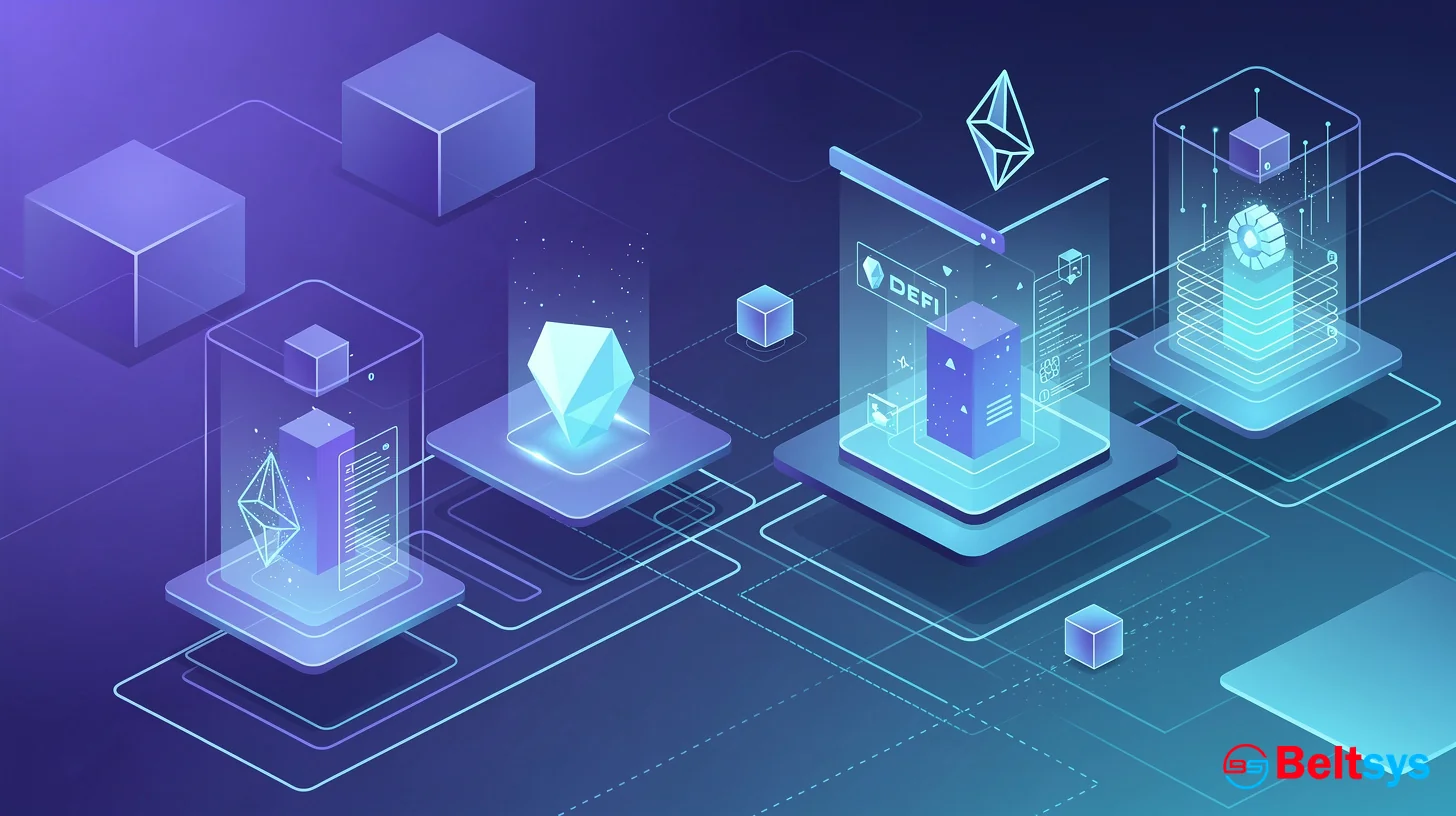
DeFi operates across three technology layers:
Layer 1: Base blockchain: Ethereum dominates DeFi with $119 billion in TVL according to Yahoo Finance. But the ecosystem has expanded to Solana, Arbitrum, Optimism, Base, and Polygon — faster and cheaper networks that broaden access while inheriting security from Ethereum (for L2s).
Layer 2: Smart contracts: Self-executing programs that implement financial logic — loan conditions, DEX pricing formulas, yield distribution rules. They are public, verifiable, and immutable once deployed. Libraries like OpenZeppelin provide audited, standardized contracts.
Layer 3: Protocols and applications: DeFi protocols are sets of smart contracts offering a specific financial service. The power of DeFi is composability: protocols combine like Lego blocks. You can stake ETH in Lido (receiving stETH), deposit stETH in Aave as collateral, borrow USDC, and deploy it in a Curve liquidity pool — all in a single transaction chain.
Oracles: Smart contracts cannot access external data (prices, exchange rates, real-world data). Oracles like Chainlink provide verified on-chain data feeds that DeFi protocols need — the ETH/USD price Aave uses for collateral calculations, or US treasury rates that MakerDAO uses for DAI backing.
The DeFi Ecosystem: Key Components
| Component | Function | Leading Protocols |
|---|---|---|
| DEX (Decentralized exchange) | Trustless token trading | Uniswap, Curve, SushiSwap |
| Lending / Borrowing | Collateralized on-chain loans | Aave, Compound, MakerDAO |
| Stablecoins | Dollar/euro-pegged tokens | DAI, USDC, USDT, GHO |
| Liquid staking | Staking with liquidity (stETH, rETH) | Lido, Rocket Pool |
| Restaking | Re-leveraging staked assets | EigenLayer |
| Yield optimization | Automated yield strategies | Yearn Finance, Beefy |
| Synthetic assets | Asset exposure without ownership | Synthetix |
| Bridges | Cross-chain transfers | Wormhole, LayerZero |
| Oracles | Real-world data on-chain | Chainlink, Pyth |
| RWA protocols | Tokenized real-world assets | Centrifuge, Ondo Finance |
Composability between these components is what makes DeFi fundamentally different from traditional finance. In TradFi, each service is a silo. In DeFi, all protocols interact on the same layer — creating financial products that are impossible in the traditional system.
Top DeFi Protocols in 2026
Lido ($33B TVL): The dominant liquid staking protocol. Deposit ETH, receive stETH (a liquid token representing your staked ETH), and use stETH across DeFi while earning ~3-4% staking yield. Lido controls over 30% of all staked ETH.
Aave ($20B+ TVL): The leading lending protocol. Deposit collateral (ETH, stablecoins, tokens), borrow other assets at variable interest. Aave v3 introduced capital efficiency with supply caps, isolation mode, and cross-chain portals. Aave’s GHO stablecoin competes directly with DAI.
EigenLayer: The restaking pioneer. Allows staked ETH to secure additional protocols beyond Ethereum consensus — amplifying capital efficiency and generating additional yield. One of the fastest-growing protocols in 2026.
Uniswap: The largest DEX by volume. Uses an automated market maker (AMM) model where liquidity providers deposit token pairs, and traders swap against those pools. Uniswap v4 introduces hooks — customizable logic that lets developers build specialized markets.
MakerDAO / Sky: Creator of DAI, the longest-running decentralized stablecoin. MakerDAO pioneered integrating RWA as collateral — US treasuries back part of DAI’s supply, generating real yield for the protocol.
Curve Finance: DEX specialized in stable asset swaps (USDC/USDT/DAI, stETH/ETH). Minimal fees and near-zero slippage for stable pairs. Essential stablecoin infrastructure.
DeFi and Real-World Assets: The Convergence Reshaping Finance
RWA (Real World Assets) in DeFi represents the most transformative trend of 2026. According to Cryptopolitan/DefiLlama, RWA displaced DEXs as the 5th largest DeFi category by TVL. Tokenized RWA on DeFi is projected to reach $300 billion in 2026 according to Yahoo Finance — shifting from isolated products to full fund complexes on-chain.
Production examples:
- MakerDAO: US treasuries as DAI collateral — generating real yield
- Centrifuge: Tokenized invoices, mortgages, and credit assets as collateral in Aave and MakerDAO
- Ondo Finance: Tokenized treasury bond access with on-chain yield
- BlackRock BUIDL: Tokenized short-term debt fund on Ethereum — the world’s largest asset manager operating on DeFi rails
This convergence is directly relevant to real estate tokenization: fractional property tokens can integrate into DeFi protocols as collateral, creating liquidity for traditionally illiquid assets.
Institutional DeFi: How TradFi and DeFi Are Merging
According to Investing.com, 2026 marks the year of TradFi-DeFi convergence. Stablecoins become capital market rails — infrastructure for settlement, payments, and treasury management.
| Institution | DeFi Activity | Significance |
|---|---|---|
| BlackRock | BUIDL tokenized fund on Ethereum | Largest asset manager on-chain |
| JPMorgan | Onyx blockchain platform | Institutional settlement |
| Goldman Sachs | Asset tokenization exploration | Investment banking on DeFi rails |
| Société Générale | FORGE: bonds tokenized on Ethereum | European bank issuing on-chain securities |
| BNY Mellon | Crypto custody for institutions | Oldest US bank serving digital assets |
The pattern is clear: institutions are not replacing their existing infrastructure with DeFi — they are integrating DeFi rails for specific functions where blockchain offers structural advantages: faster settlement, 24/7 operation, transparent collateral management, and programmable compliance.
The DeFi Market in 2026: Data and Statistics
| Metric | Value | Source |
|---|---|---|
| Total Value Locked | $130-140B | CoinLaw/ZebPay |
| Ethereum TVL | $119B | Yahoo Finance |
| Top 100 DeFi tokens market cap | $90-100B | CoinLaw |
| DeFi data & analytics market | $4.82B (2025) → $245.7B (2033) | NFTPlazas |
| CAGR | 67.5% | NFTPlazas |
| Projected RWA on DeFi | $300B in 2026 | Yahoo Finance |
| Post-FTX low | ~$50B TVL | Industry data |
| Resilience test | $97B deleveraging, <0.4% at risk | BlockEden |
The recovery from $50B to $130-140B TVL demonstrates DeFi’s structural resilience. Unlike CeFi collapses (FTX, Celsius), DeFi protocols continued operating throughout every market crisis — smart contracts execute regardless of market conditions.
DeFi on Bitcoin: The New Frontier
Rootstock (RSK): Bitcoin sidechain with EVM compatibility, $160M TVL according to Margex. Enables smart contracts and DeFi protocols using BTC as the base asset.
Merlin Chain: ZK-rollup on Bitcoin scaling native DeFi on the most secure blockchain. Integrates Ordinals, BRC-20 tokens, and lending protocols.
Lightning Network: While technically a payment network, Lightning enables instant micro-transactions being integrated with DeFi protocols for low-value payments and rapid settlement.
Bitcoin DeFi is early compared to Ethereum, but the thesis is compelling: DeFi on the most secure and decentralized blockchain in existence, with Bitcoin as native collateral.
DeFi Regulation: MiCA, SEC, and Global Frameworks
MiCA (EUR-Lex 2023) presents a challenge for DeFi: how do you regulate a decentralized protocol without a legal entity?
- Truly decentralized protocols (no controlling entity): Outside MiCA scope
- Platforms with managed interfaces (frontend controlled by a company): The operating company may be classified as a regulated service provider
- Stablecoins in DeFi: Issuers like Circle (USDC) need MiCA authorization; protocols using stablecoins do not necessarily
In the US, the SEC has taken enforcement actions against DeFi projects deemed to offer unregistered securities. The CFTC has jurisdiction over derivatives-like DeFi products. Regulatory clarity remains limited, but the trend is toward accommodation rather than prohibition — particularly as institutional adoption grows.
Risks and Security in DeFi
DeFi is not risk-free — over $6 billion has been lost to smart contract exploits since the ecosystem’s inception:
- Smart contract bugs: Code errors allowing fund drainage. Audits (Trail of Bits, OpenZeppelin, Certik) reduce risk but cannot eliminate it.
- Flash loan attacks: Uncollateralized instant loans used to manipulate DEX prices and drain protocols.
- Rug pulls: Developers abandoning projects and absconding with user funds.
- Oracle manipulation: Incorrect oracle data triggering erroneous liquidations.
- Impermanent loss: Temporary loss for AMM liquidity providers when token prices diverge significantly.
The ecosystem’s resilience has improved materially. The $97 billion deleveraging event left only $53 million in positions near liquidation — less than 0.4% of capital at risk. Mature protocols like Aave and MakerDAO have demonstrated robustness across multiple market crises.
How to Get Started with DeFi: Step-by-Step
1. Set up a wallet: MetaMask is the standard for Ethereum and EVM networks. Install the browser extension, securely store your seed phrase (offline, never digital), and connect to your desired network.
2. Acquire crypto: Buy ETH or stablecoins (USDC) on a regulated exchange (Coinbase, Kraken) and transfer to your wallet.
3. Connect to a protocol: Visit the protocol’s official interface (app.uniswap.org, app.aave.com) and connect your wallet. Always verify the URL is official — phishing is the most common risk for new users.
4. Start with low risk: Deposit stablecoins (USDC, DAI) in Aave to earn lending yield — this is the lowest-risk DeFi operation. Avoid aggressive yield farming until you understand the risks.
5. Diversify and learn: Never concentrate all funds in one protocol. Test different strategies with small amounts. Monitor positions with tools like Zapper or DeBank.
How Beltsys Builds DeFi Infrastructure
At Beltsys, we have been building DeFi and Web3 infrastructure since 2016, with over 300 projects delivered:
- Smart contracts: DeFi protocol development, liquidity pools, staking and lending contracts with integrated audits
- DeFi-RWA integration: Architectures connecting tokenized assets (ERC-3643) with DeFi protocols as collateral or yield sources
- Web3 development: DApps with DeFi integration, ERC-4337 smart wallets, protocol interfaces
- Blockchain consulting: DeFi treasury strategies, stablecoin payments, tokenization architecture
If you want to integrate DeFi into your business operations or build a protocol, contact our team.
Frequently Asked Questions about DeFi
What is DeFi in simple terms?
DeFi (Decentralized Finance) is an ecosystem of financial applications on blockchain offering lending, trading, and yield generation without centralized intermediaries. Smart contracts execute operations automatically based on public, transparent rules. In 2026, DeFi manages $130-140 billion in total value locked across protocols.
Is DeFi safe?
DeFi has specific risks: smart contract bugs, flash loan attacks, rug pulls, and oracle manipulation. Over $6 billion has been lost to exploits. However, mature protocols like Aave and MakerDAO have proven resilient across multiple crises. Using audited protocols, diversifying, and starting with small amounts is key.
What is the difference between DeFi and CeFi?
CeFi means a company custodies your funds and executes operations for you — like a bank or exchange. DeFi eliminates the intermediary: your funds remain in smart contracts you control (self-custody) with full on-chain transparency. CeFi has counterparty risk; DeFi has smart contract risk.
How do you make money with DeFi?
Main methods: lending (deposit assets for 3-8% yield on stablecoins), liquid staking (stake ETH via Lido for ~3-4%), providing liquidity on DEXs (trading fees + incentives), and yield farming (automated optimization). Returns are variable and carry risk — there are no high yields without risk.
What are RWA in DeFi?
RWA (Real World Assets) are tokenized representations of traditional financial assets — US treasuries, corporate debt, real estate — deployed on DeFi protocols. They are the 5th largest DeFi category by TVL. They enable traditional assets to generate on-chain yield and serve as collateral in protocols like Aave and MakerDAO.
Does MiCA regulate DeFi in Europe?
MiCA does not regulate truly decentralized protocols without a controlling entity. But platforms with managed interfaces may be classified as regulated service providers. Stablecoin issuers used in DeFi need MiCA authorization. Regulatory guidance is still evolving.
About the Author
Beltsys is a Spanish blockchain development company specializing in smart contracts, DeFi infrastructure, and real-world asset tokenization. With extensive experience across more than 300 projects since 2016, Beltsys builds the technology connecting decentralized finance with real enterprise needs — from lending protocols to hybrid DeFi-RWA architectures with ERC-3643. Learn more about Beltsys
Related: Smart Contract Development Related: Real Estate Tokenization Related: Web3 Development Related: Blockchain Consulting