

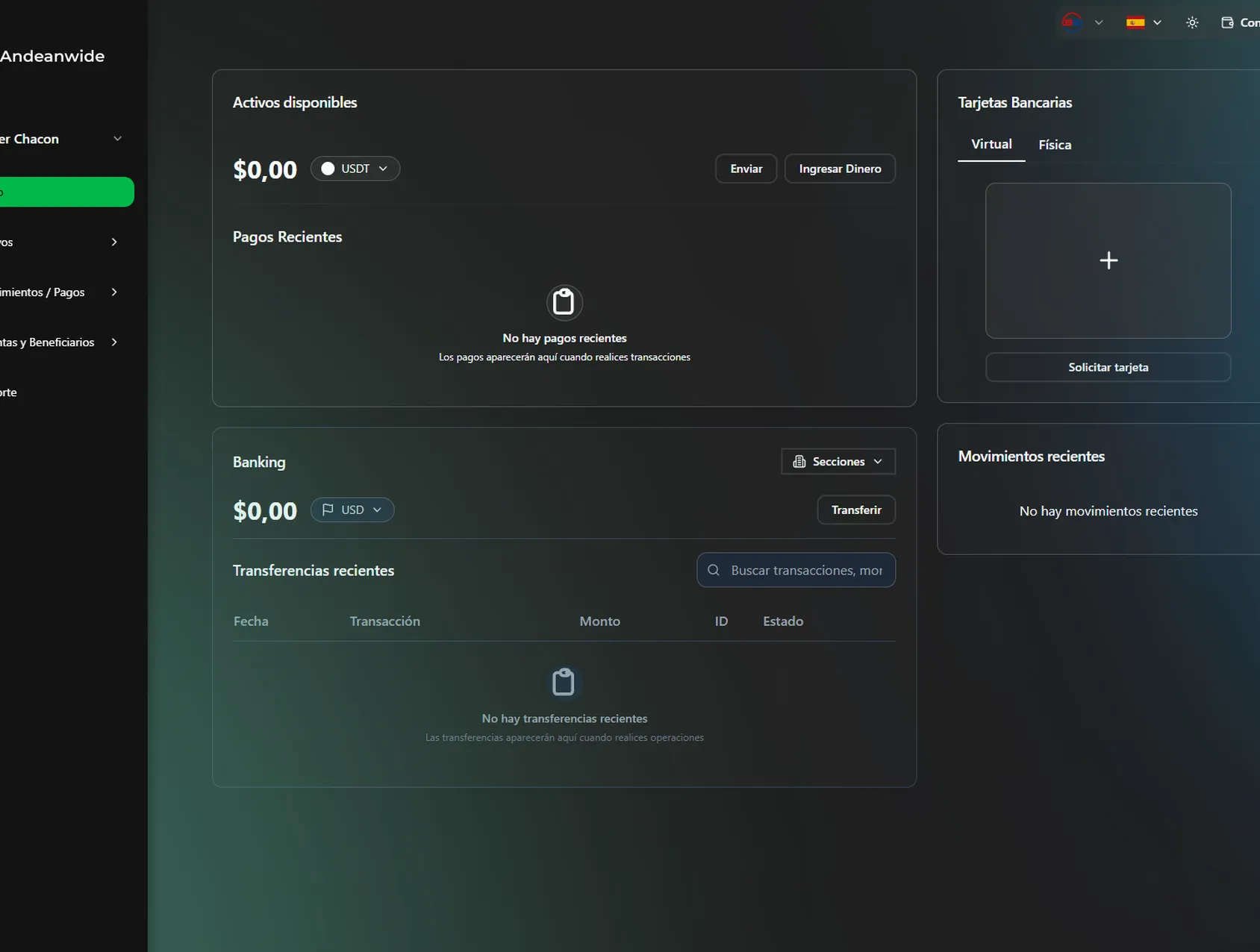
Andeanwide is a fintech specialized in cross-border payments across Latin America. Its value proposition focuses on removing the friction inherent to traditional international transfers by replacing correspondent banking networks with an infrastructure built on blockchain and stablecoins. Beltsys Labs was involved in designing and implementing the technical architecture that powers this operation.
Development Challenge
Cross-border payments in Latin America face a series of structural challenges that hinder trade and remittances between countries in the region. Conventional international transfers rely on correspondent banking chains, which involve multiple intermediaries, currency conversions at each hop, and settlement times that can stretch from two to five business days. The fees accumulated by each intermediary significantly increase the total cost of every transaction.
Adding to this is the regulatory fragmentation across the region. Each country has its own foreign exchange regulations, compliance requirements, and restrictions on capital flows. Designing a system that operates within these diverse regulatory frameworks while maintaining agility and low cost was the project’s primary technical challenge.
The goal was to build a platform that could settle payments in minutes at drastically lower costs, and that could scale to multiple payment corridors across Latin America without relying on traditional banking infrastructure as the primary channel.
Technical Solution
Choosing the Stellar Network
After evaluating several blockchain networks, Stellar was selected as the primary settlement layer. Stellar offers transaction finality in a range of three to five seconds, virtually negligible network fees, and a consensus protocol (SCP) specifically designed for financial transactions. Unlike proof-of-work networks, Stellar does not suffer from congestion issues that could delay settlements during periods of high demand.
The Stellar network also natively incorporates a decentralized exchange (SDEX) and support for tokenized assets, which facilitates the creation of stablecoin corridors between Latin American currency pairs without the need to deploy complex smart contracts.
Stablecoin Corridors and Multi-Currency Settlement
The payment architecture is structured around corridors connecting currency pairs (for example, COP-PEN, BRL-CLP). Each corridor uses stablecoins as an intermediary settlement asset. The typical transaction flow follows this pattern: the origin currency is converted to a stablecoin at the entry point, the stablecoin is transferred across the Stellar network to the destination point, and there it is converted to the local currency for delivery to the beneficiary.
This model eliminates the need to maintain correspondent accounts in each country and allows new corridors to be added in a modular fashion as geographic coverage expands.
Integration API with Node.js
The system backend was developed in Node.js, exposing a RESTful API that enables financial institutions, fintechs, and businesses to integrate Andeanwide’s payment services into their own systems. The API handles payment order creation, beneficiary verification, real-time transaction tracking, and status notifications via webhooks.
The Node.js middleware also manages communication with the Stellar network through the official SDK, handling transaction signing, account sequence management, and recovery from network failures.
Operations Dashboard with React
An operations dashboard was built in React for the Andeanwide team, providing real-time monitoring of all transaction statuses, liquidity levels across each corridor, applied conversion rates, and regulatory limit compliance. The dashboard includes configurable alerts for situations requiring manual intervention, such as transactions exceeding predefined thresholds or liquidity imbalances in any corridor.
Regulatory Compliance
The system incorporates KYC/AML modules adapted to the regulations of each jurisdiction where Andeanwide operates. Identity verification and transaction monitoring workflows were designed to be configurable per country, allowing thresholds, required documentation, and suspicious activity detection rules to be adjusted according to local requirements.
Results
The platform reduced cross-border payment settlement times from a range of two to five days down to a matter of minutes. Per-transaction costs were reduced by approximately 80% compared to traditional banking alternatives, thanks to the elimination of intermediaries and the use of a settlement network with minimal fees.
The modular corridor architecture enabled progressive coverage expansion across multiple Latin American countries, incorporating new currency pairs without redesigning the underlying infrastructure. The system processes transactions continuously with high availability, and the operations dashboard provides complete visibility into the status of every payment at all times.