

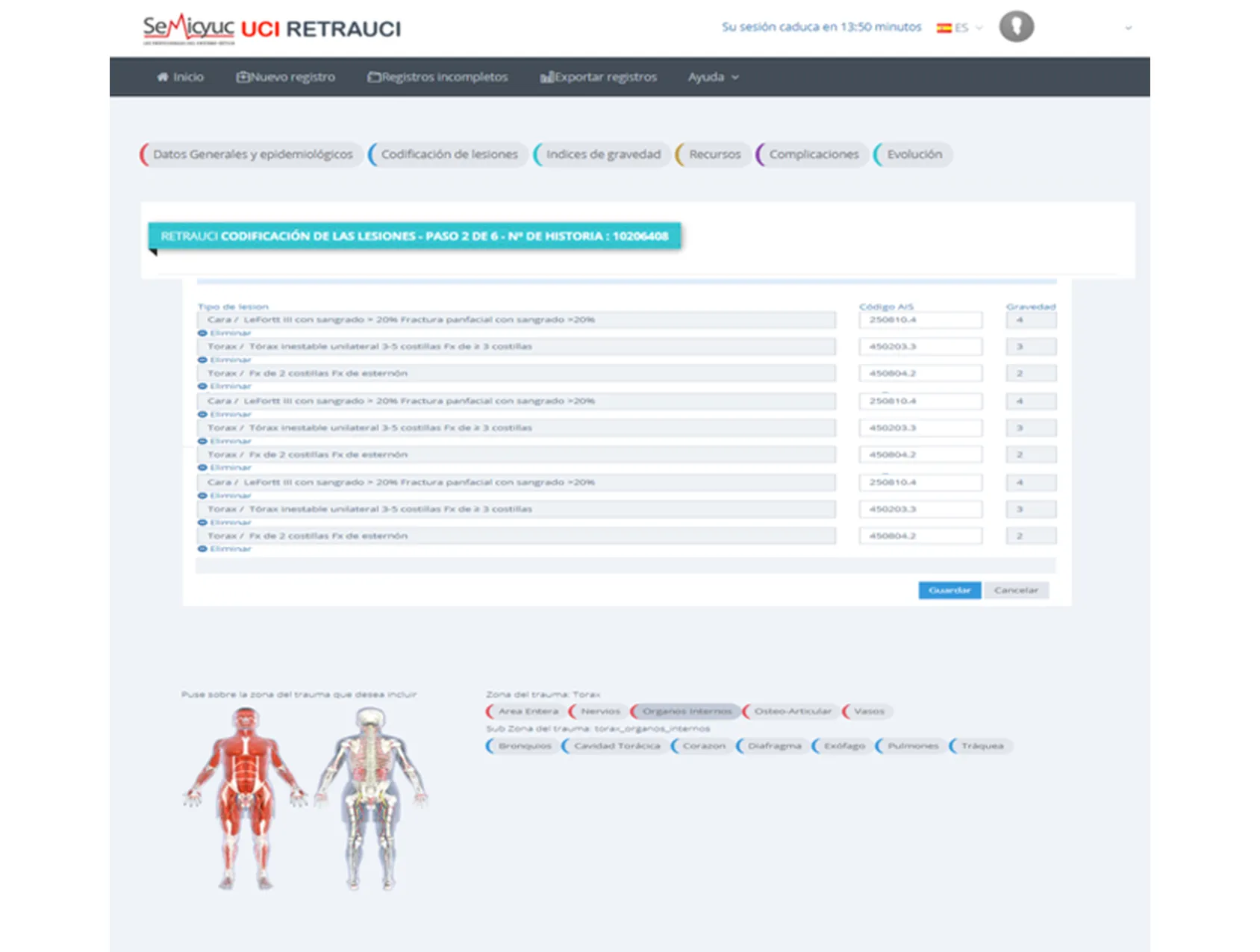
RETRAUCI is the ICU Trauma Registry, a national initiative driven by SEMICYUC (the Spanish Society of Intensive, Critical Care and Coronary Unit Medicine) to monitor and improve the management of critical trauma patients across hospitals in Spain. The system enables intensivists and clinical staff to record structured data for each severe trauma case directly from the ICU, feeding a national database that serves as a tool for research and quality improvement in patient care.
Development Challenge
The primary challenge was to build a digital registry capable of performing reliably within hospital environments that have limited network infrastructure. Internal networks at many Spanish hospitals operate with restricted bandwidth and strict security policies, which ruled out solutions built on heavy frameworks with large dependency trees.
Additionally, the system had to meet healthcare-specific requirements:
- Medical data protection: Compliance with LOPD and GDPR for handling sensitive clinical data, including encryption in transit and at rest.
- Role-based access: The registry needed to support distinct profiles for intensivists, nurses, researchers, and administrators at each center, each with specific permissions and views.
- Registration speed: In an ICU setting, clinical staff have limited time. The complete data entry process for a single case had to be reduced to the minimum possible.
- Multi-center architecture: Each hospital had to manage its own data autonomously, while anonymized data was aggregated at a national level for research purposes.
Technical Solution
Framework-free architecture decision
After evaluating several options, we chose a web architecture built entirely with HTML5, pure SCSS, and vanilla JavaScript. This decision was driven by a practical need: eliminating the overhead of commercial frameworks that were unnecessarily heavy for hospital network connections. By removing external libraries, we drastically reduced the application footprint and eliminated dependencies that could cause incompatibilities with hospital browsers and security configurations.
Custom SCSS components for medical forms
Trauma registry forms are inherently complex: they include clinical scales, conditional fields, and cross-section validations. We developed custom SCSS components that provide fluid animations for transitions between form sections, visual progress indicators, and validation states, all without relying on external UI libraries. This enables clinical staff to navigate quickly between different sections of the registry.
Node.js backend for data aggregation
The Node.js backend manages data aggregation from multiple hospital centers. Each hospital operates with its own data instance, and the system centralizes anonymized information for statistical analysis at a national level. The API handles inter-center synchronization, role and permission management, and the generation of aggregate reports for researchers.
ICU data entry workflow
The data entry workflow was designed specifically for the ICU context. Clinical staff access the registry, select the case type, and complete fields organized in logical sections that mirror the trauma care protocol. Conditional fields are shown or hidden automatically based on previous responses, reducing the amount of visible information at each step and accelerating the registration process.
Results
The RETRAUCI implementation reduced the average data collection time per case from 4 to 3 minutes, a significant improvement when considering the case volume managed by each center. The complete elimination of commercial frameworks resulted in minimal load times even on hospital connections with limited bandwidth.
The structured role system allows each hospital to manage its own information independently, while SEMICYUC accesses aggregated and anonymized data at a national level. This multi-center architecture facilitates epidemiological research on severe trauma in Spain without compromising the privacy of individual clinical data at each center.